
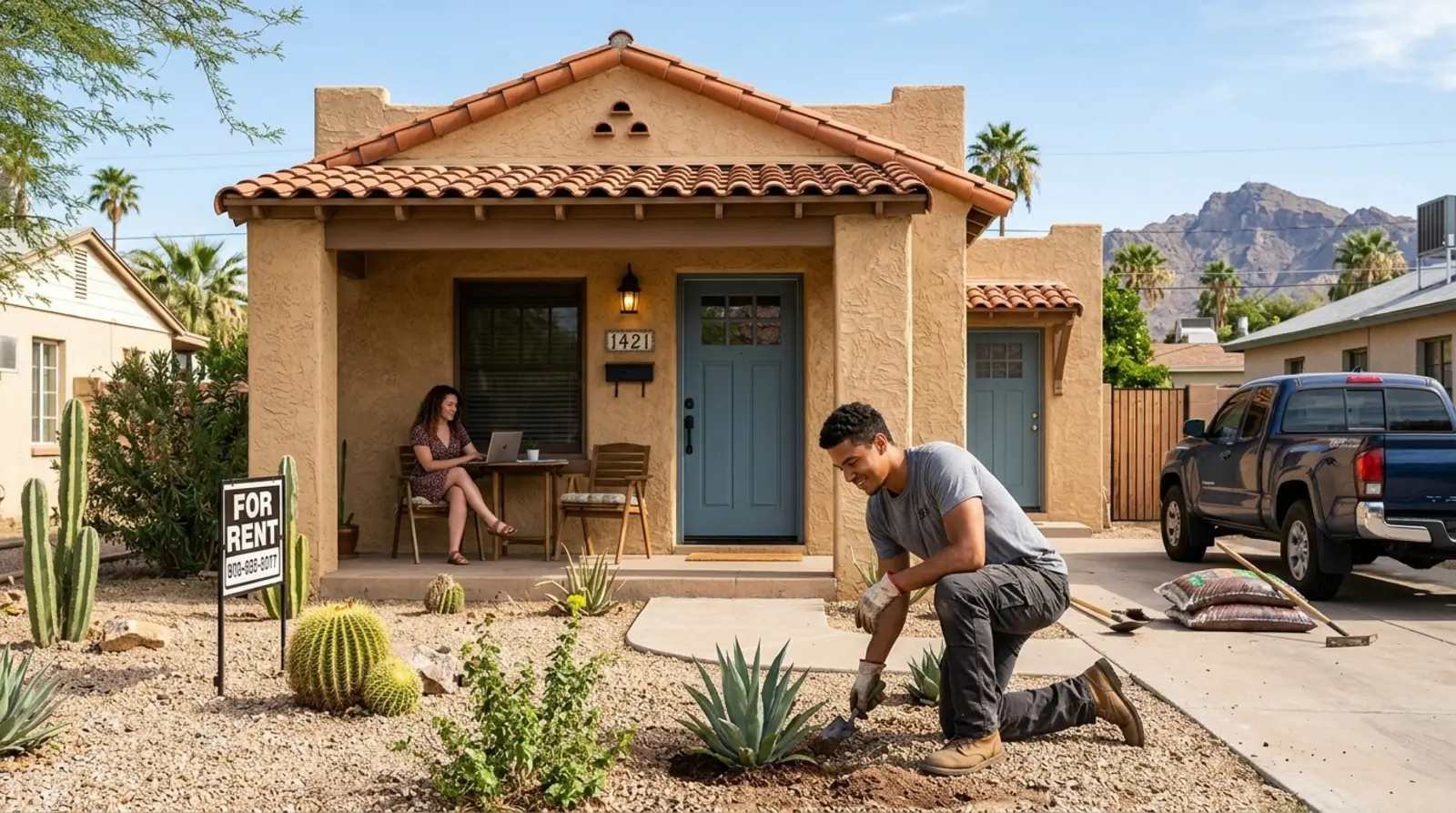
Think you need 20% or 25% down to buy your first rental property?
You may not.
For aspiring real estate investors in Phoenix, house hacking can provide a path to property ownership with significantly less cash upfront by combining owner-occupied financing with rental income.
Instead of buying a traditional investment property, you purchase a home as your primary residence and rent out another portion of the property. That could mean buying a duplex and living in one unit, purchasing a triplex or fourplex, renting bedrooms, or buying a Phoenix home with an accessory dwelling unit (ADU) or casita.
The result: you get a place to live and an income-producing property at the same time.
As a Phoenix property management company, Rosenbaum Realty Group works with rental property owners throughout the Valley. For buyers who want to start building a real estate portfolio without making a traditional investment-property down payment, house hacking is a strategy worth understanding.
Key Takeaways
- House hacking means living in a property while renting another portion of it to help offset your housing costs.
- FHA financing may allow qualified buyers to purchase a 1-4 unit property with as little as 3.5% down when the property is their primary residence.
- Rental income from other units may potentially help a borrower qualify for the mortgage, subject to lender and loan-program requirements.
- Phoenix and Arizona's evolving ADU rules have created additional opportunities for homeowners interested in adding or renting a casita.
- House hacking can be an entry point into rental property ownership, but buyers still need to evaluate rents, expenses, maintenance, vacancy and long-term investment potential.
What Is House Hacking?
House hacking is a real estate strategy where you buy a property, live in part of it and rent out the rest.
The rental income helps offset your mortgage and other housing expenses.
For example, you could:
- Buy a duplex and live in one unit while renting the other.
- Buy a triplex or fourplex and occupy one unit.
- Purchase a home with an existing guest house or casita.
- Buy a property where adding an ADU may be feasible.
- In certain situations, rent bedrooms within your primary residence.
The goal isn't simply to reduce your housing payment.
For many investors, the bigger objective is to turn their first home purchase into the first property in a long-term rental portfolio.
Why House Hacking Can Require Less Cash Upfront
One of the biggest barriers to buying an investment property is the down payment.
A traditional investment-property mortgage may require substantially more money down than financing for a primary residence.
House hacking changes the equation because you're purchasing the property as your primary residence.
For qualified borrowers, an FHA loan can allow a down payment as low as 3.5% on eligible one- to four-unit properties, provided the borrower meets FHA requirements and occupies the property as a primary residence.
Qualified veterans and service members may also have VA financing options that can make owner-occupied multi-unit properties attractive.
Conventional financing programs may provide additional options depending on the borrower's financial situation and property.
What Could That Look Like?
Consider a hypothetical $550,000 Phoenix duplex.
At 3.5% down, the base down payment would be approximately:
$550,000 × 3.5% = $19,250
Compare that with putting 20% down:
$550,000 × 20% = $110,000
That's a difference of more than $90,000 in upfront down payment.
Now imagine living in one unit while renting the other for $1,800 per month.
That rent doesn't make the property free, and there are still mortgage payments, taxes, insurance, mortgage insurance, maintenance, vacancies and other expenses to consider.
But you're now using an asset to generate income while simultaneously providing your own housing.
This example is for illustration only and is not a loan quote or representation of actual financing terms. Down payment is only one component of the cash required to purchase a property. Loan qualification, closing costs, reserves, mortgage insurance and other requirements vary.
Rental Income May Help You Qualify
Here's another reason house hacking can be powerful.
With an eligible multi-unit property, a lender may be able to consider qualifying rental income from the units you won't occupy when underwriting the mortgage.
The exact calculation depends on the loan program, property and borrower. Lenders commonly apply vacancy or expense factors rather than simply counting every dollar of projected rent as income.
That means someone who couldn't qualify for a particular property based solely on employment income may potentially qualify when eligible rental income is considered.
Talk with a knowledgeable mortgage lender before shopping for a multi-unit property.
You want to understand exactly how much rental income the lender can use and what documentation will be required before you make an offer.
FHA Loan Limits Matter for Phoenix House Hackers
FHA loan limits increase for properties with multiple units.
For 2026, the national FHA floor limits are:
- 1 Unit: $541,287
- 2 Units: $693,050
- 3 Units: $837,700
- 4 Units: $1,041,125
Actual FHA limits can vary by county, so Phoenix-area buyers should verify the current limit for Maricopa County and the specific property type before shopping.
Why does this matter?
Because a buyer looking at a fourplex potentially has access to a much higher FHA loan limit than someone purchasing a single-family property.
Don't Forget the Numbers Just Because You Can Buy With Less Down
This is one of the most important parts of house hacking.
Low down payment doesn't automatically mean good investment.
Before buying, estimate:
- Market rent for every rentable unit
- Mortgage payment
- Property taxes
- Insurance
- Mortgage insurance, if applicable
- Utilities paid by the owner
- Repairs and maintenance
- Capital expenditures
- Vacancy
- Property management
- HOA expenses, if applicable
You should know what the property is likely to look like financially while you live there and after you eventually move out.
That second calculation is particularly important.
The property may save you money while you're occupying one unit, but will it still make sense as a full rental?
Phoenix ADUs Create Another House Hacking Opportunity
A duplex or fourplex isn't the only way to house hack.
Arizona's changing ADU laws have expanded opportunities for homeowners interested in adding or utilizing backyard casitas.
This creates another potential strategy:
Buy a single-family Phoenix home → live in the main house → rent an eligible existing casita or ADU.
Or depending on the property and applicable zoning and building requirements:
Buy a home → add an ADU → create another potential source of rental income.
Fannie Mae guidelines also allow qualifying rental income from one existing ADU on certain one-unit primary residences, subject to program requirements. The amount of qualifying ADU rental income is limited to 30% of total qualifying income.
If you're considering this strategy, read our complete guide: Arizona ADU Law: Can Phoenix Owners Add a Casita for Rental Income?
The Owner-Occupancy Requirement Matters
House hacking isn't a way to disguise an investment property as a primary residence.
If you're obtaining owner-occupied financing, you must legitimately intend to occupy the property as your primary residence and comply with the requirements of your mortgage.
For FHA financing, borrowers generally must establish occupancy within the required timeframe and intend to continue occupying the property as a principal residence for at least one year, subject to applicable FHA rules and exceptions.
Once you've satisfied your loan's occupancy requirements and later legitimately move, the property may potentially become a full rental.
That's where house hacking can become especially interesting.
Property #1
Buy an owner-occupied property and rent a portion of it.
Later
Move to another residence when your circumstances and financing permit.
Property #1 Becomes a Rental
Your former home can potentially become a fully income-producing property.
Over time, this can provide a path from homeowner → landlord → real estate investor.
When House Hacking May NOT Be a Good Idea
House hacking isn't right for everyone.
Be cautious if:
- You're stretching your budget simply to qualify.
- The property's rents don't support the purchase price.
- You don't have cash reserves for unexpected repairs.
- The property requires major deferred maintenance.
- You aren't comfortable living near your tenants.
- You're relying on 100% occupancy to make the numbers work.
- You're assuming rents will increase rapidly.
- You're buying primarily because the financing is attractive rather than because the property itself is a good investment.
Financing can help you buy a property.
It doesn't make a bad investment a good one.
Should You Manage the Rental Yourself?
Living next door to your tenant sounds convenient.
It can also make management more complicated.
Your tenants know exactly where you live. They may see you as their neighbor instead of their landlord, which can make boundaries around late rent, maintenance requests, lease enforcement and other issues more difficult.
Professional property management can help separate the personal relationship from the landlord-tenant relationship.
At Rosenbaum Realty Group, we help Phoenix-area rental property owners with services including tenant screening, leasing, rent collection, maintenance coordination and ongoing property management.
Even if this is your first rental property, it should be managed like an investment from day one.
Frequently Asked Questions About House Hacking in Phoenix
Can I buy a duplex with an FHA loan?
Potentially, yes. FHA financing can be used for eligible properties containing up to four units when the borrower meets program requirements and uses the property as a primary residence.
Do I need 20% down to buy my first rental property?
Not necessarily. If you're legitimately purchasing a property as your primary residence and renting another portion of it, owner-occupied financing may provide substantially lower down-payment options than a traditional investment-property loan.
Can rental income help me qualify for the mortgage?
Potentially. Depending on the property, loan program and your circumstances, eligible rental income may be considered during underwriting. Your lender can determine exactly how much income can be used.
Can I house hack a single-family home in Phoenix?
Yes. A single-family property with an eligible existing ADU or casita can potentially provide a house-hacking opportunity. Renting bedrooms may also be an option, although financing rules regarding boarder income differ from rental income generated by separate units.
Can I move out later and rent the entire property?
Potentially, after satisfying the occupancy requirements associated with your mortgage. Review your specific loan documents and lender requirements before making this change.
Is house hacking a good way to start investing in Phoenix real estate?
It can be. House hacking can reduce the amount of cash needed to enter real estate investing while giving a new investor firsthand experience owning rental property. But the property still needs to make financial sense.
Before You Buy, Find Out What the Property Could Actually Rent For
The mortgage is only half of the house-hacking equation.
The other half is rent.
Before making an offer on a Phoenix duplex, triplex, fourplex, casita or other potential rental property, understanding realistic market rent can help you determine whether the numbers actually work.
Rosenbaum Realty Group helps Phoenix rental property owners understand local rental rates and professionally manage their properties.
Find out what your Phoenix property could rent for by requesting a free rental analysis, or learn more about our Phoenix Property Management Services and Tenant Screening Services.